Only news originating in Latin America, ranked for the selected language
· N GLOBE
TOP STORYVerified report
Mexico · Environment / disaster
Update: Polo rapidly strengthens into a Category 1 hurricane off Mexico's Pacific coast
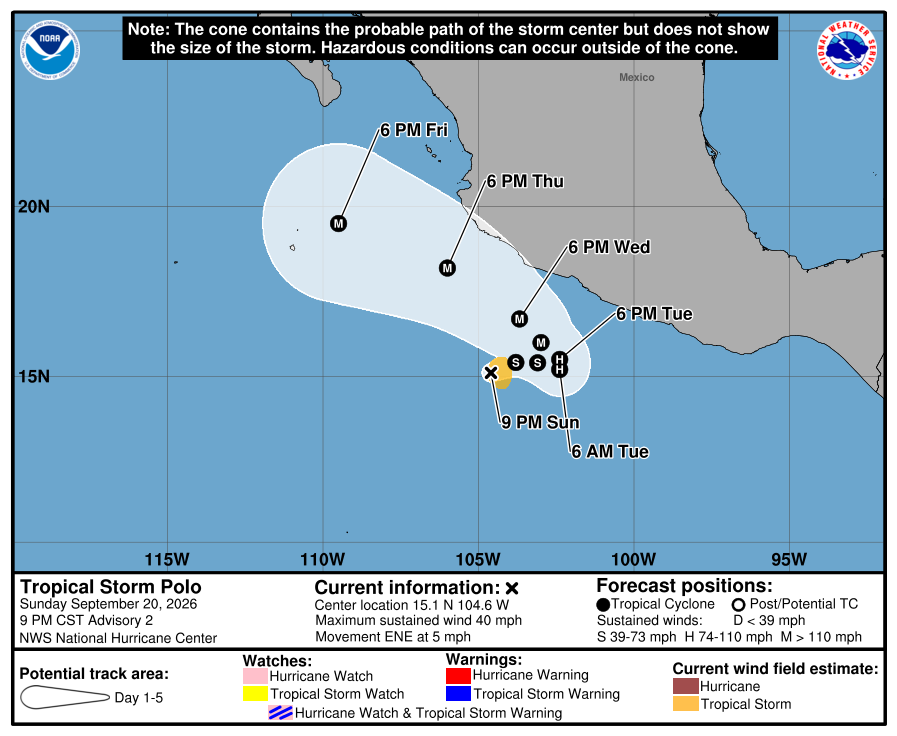
The U.S. National Hurricane Center says Polo has rapidly strengthened from a tropical storm into a Category 1 hurricane, with maximum sustained winds near 129 km/h. The storm is forecast to track offshore along western Mexico, while coastal Guerrero and Michoacan could receive isolated rainfall totals near 300 millimetres through Thursday.
Why it matters
Polo remains offshore and could become a major hurricane later this week. Tropical-storm-force winds, heavy rain and rough surf may affect parts of southwestern Mexico from late Tuesday into Wednesday, so residents should follow current NHC and Mexican-authority alerts.
美國國家颶風中心5日預報路徑圖,發布於2026年9月21日03:00 UTC · U.S. National Hurricane Center
More important stories
Cuba · Nationwide blackout
N Globe editorial illustration
Cuba · Nationwide blackout
Cuba’s national power grid collapses, blacking out an island of about 9 million people
Cuba’s Ministry of Energy and Mines said on September 18 that the national electricity system had suffered a total collapse, causing an islandwide blackout. Officials had not yet announced the cause, a restoration timetable or the extent of early reconnection work.
This is a nationwide critical-infrastructure failure. Hospitals, water systems, communications, transport and food refrigeration may have to rely on backup power, but the actual effect on those services had not yet been officially detailed.
New route could widen twice-yearly HIV prevention access in 14 Latin American countries
Gilead and the Pan American Health Organization agreed on September 15 to let 14 Latin American and Caribbean countries, including Brazil, Mexico, Argentina and Chile, choose to procure the twice-yearly HIV prevention medicine lenacapavir through PAHO's regional purchasing system.
The agreement creates a procurement route, not immediate free availability. Each country must still decide whether to participate and complete its own regulatory, pricing and public-health purchasing steps; people seeking prevention should continue using locally approved PrEP services.
Panama Canal cuts daily transit slots to 32 from today
The Panama Canal Authority says below-expected watershed rainfall means Panamax daily slots fall to 23 on September 15. Together with nine Neopanamax slots, the canal's daily transit capacity is now 32.
Vessels without reservations may wait longer, so shipping, retail and manufacturing businesses should watch schedules and freight costs. The adjustment does not mean the canal is closed.
Chile becomes first South American country validated for eliminating dog-transmitted rabies
The World Health Organization confirmed on September 14 that Chile has eliminated dog-transmitted human rabies as a public-health problem, becoming the first South American country to receive this validation. Chile last reported a dog-to-human rabies case in 1972.
The result shows that sustained animal vaccination, surveillance and timely treatment after exposure can end dog-mediated transmission. It does not mean every form of animal rabies has disappeared; anyone bitten or scratched by a potentially infected animal still needs immediate wound care and medical advice.
São Paulo participatory-council candidate registration closes September 16
The City of São Paulo says candidate registration for the Municipal Participatory Council elections closes on Wednesday, September 16. Residents elect the councils to represent districts in local civic issues.
Prospective candidates should immediately verify eligibility, documents and the filing route on the official city page. This is the candidate-registration deadline, not the public voting date.

 Cuba · Nationwide blackout